Our 1st and 2nd graders are wrapping up a unit on visual-spatial reasoning with a lesson on tangrams--an ancient geometrical puzzle and storytelling tool comprised of 7 pieces. The video below introduces their origin.
OK, so that's not the actual origin of trangrams, but it is an excellent introduction. In class we manipulated physical tangrams, but there are some nice websites with tangram activities too:
Matter - Online Tangram Puzzles
PBS Kids - Sagwa Tangram Games
Think a 7-piece puzzle sounds too easy? Think again!
Showing posts with label curriculum. Show all posts
Showing posts with label curriculum. Show all posts
Tuesday, April 3, 2012

Friday, March 30, 2012
How to Crack a Caesar Cipher!
We spent time earlier this year learning how a substitution cipher that goes all the way back to Julius Caesar has been used throughout history. We made our own cipher wheels in class and enciphered our own messages. You've even cracked a couple on this blog!
The Caesar Cipher
All Hail the Newest Code Challenge
Well, the Caesar Cipher worked pretty well for a few hundred years, but eventually a really smart Arab mathematician figured out how to crack it using a method called "frequency analysis." The video below from KhanAcademy.com explains.
The Caesar Cipher
All Hail the Newest Code Challenge
Well, the Caesar Cipher worked pretty well for a few hundred years, but eventually a really smart Arab mathematician figured out how to crack it using a method called "frequency analysis." The video below from KhanAcademy.com explains.
Thursday, March 29, 2012
Myers-Briggs Super Hero Projects
Perhaps you've had a chance to explore the Voki which describes each dimension of the Myers-Briggs personality assessment that our 4th and 5th graders took. One way we used the data and insight about our personalities was to develop a "Super Hero" with super traits based on our personality profiles. Before we got too carried away though, we also had to analyze our profiles for possible weaknesses, and imagine those onto our alter egos as well (hey, even Superman has kryptonite!)
These are up in the room at both campuses, and you'll get to see them when they come home with most of our work toward the end of the year. One of our most popular heroes has been "Neona" from Hannah at Isbell (an "INTP"). Next time I'm in trouble, I hope she's nearby!

These are up in the room at both campuses, and you'll get to see them when they come home with most of our work toward the end of the year. One of our most popular heroes has been "Neona" from Hannah at Isbell (an "INTP"). Next time I'm in trouble, I hope she's nearby!

Thursday, March 22, 2012
The Puzzling World of Winston Breen: Student Book Reviews
Our 5th graders have been working through the first Winston Breen novel as a way of connecting our work on codes and ciphers with literature. One of the project options was to create a book review. Elizabeth, Shobha and Michelle from Isbell prepared the first review below, and it is following by a review from Kathryn, also from Isbell.
You can learn more about this book at http://www.winstonbreen.com
****

****
You can learn more about this book at http://www.winstonbreen.com
****
by Elizabeth, Shobha and Michelle
Winston Breen is a boy who loves creating and solving puzzles. He buys a jewelry box at Penrose’s store of random things for his sister’s birthday. When his sister reveals a hidden compartment, a mystery arises involving four baffling wooden strips (with letters on them), a librarian, two strange men- and don’t forget, Winston and his sister, Katie. They go on an adventure to find the hidden treasure that the mysterious strips tell of. Will they find the concealed treasure, or will they fall into the depths of the unsolved mystery?
I liked Winston Breen because it involves adventure, a mystery and many puzzles as well. Winston Breen is an enjoyable book, but remember, if you get stuck on one of the puzzles there are answers in the back of the book. If you can help it, try not to look at the answers, use your brain. The mysteriousness of Winston Breen is intriguing. If you have read this book before… Good for you!!!! Keep in mind that The Puzzling world of Winston Breen is a cool book; try to solve all the puzzles too!
I recommend this book to a quieter individual who likes a mystery. To get full pleasure out of this book you should have constant time to read and solve puzzles instead of only 2 hours a week. You can still read this if you have minimal time; it is just not as enjoyable. Winston Breen is a very good book for middle schoolers. I also propose this novel to advanced readers in GT, Quest, LEAP, Pace, or AIM. If you like this book, I advise you read the sequel, “Potato Chip Puzzles”. I adore Winston and hope you do to. ****
By Kathryn
The puzzling world of Winston Breen is a novel that starts with an innocent present that spirals in to a full blown treasure hunt with backstabbing and double crossing. As Winston pieces together the puzzle he finds he can trust.
I believe this book has amazing puzzles and a twisted plot. Though I lost interest in the beginning but it somewhat sets the story up. Overall an amazing story with good content.
I recommend this book to anyone with a love of puzzles because the plot is based on the puzzles.
Monday, February 13, 2012
Chasing Vermeer Activities

Thursday, February 9, 2012
Personality Profiles: True Colors and Myers-Briggs
One of our major focuses since coming back from Winter Break has been on discovering truths about our own personalities and how we relate to the world and others. Different grade levels used different personality tools, and below you'll find a Prezi presentation for both of the profiles we used. Videos are used to highlight characters who demonstrate the discussed personality traits. You can zoom in and out of the Prezi using the controls.
If you have trouble viewing the Prezi's below, you can link to online versions of them here:
If you have trouble viewing the Prezi's below, you can link to online versions of them here:
1st through 3rd Grade: What's Your True Color?
4th and 5th Grade: Myers-Briggs
Wednesday, February 8, 2012
Build Verbal Reasoning Skills with Quiddler

Just as with SET, there is an online Quiddler puzzle that refreshes daily. The site also includes a printable "worksheet" version of each daily puzzle.
Monday, February 6, 2012
Build Non Verbal Reasoning Skills with "SET"

The rules of what makes up a set are both extremely simple and very intricate and subtle. The good news is we've been playing it as a warm-up exercise in class recently so your child should know! And even better news, your child (and you) can get a free non verbal workout everyday on the SET Daily Puzzle website. Each day they refresh the page with a new SET challenge.
I HIGHLY recommend encouraging your child to visit it regularly to build up those dendrites and synaptic connections involved in complex non verbal logic and reasoning.
P.S. I'll also include a permanent link to the SET Daily Puzzle on the Games and Stimulation page of the website.
Tuesday, January 10, 2012
Navajo Codetalker Update: In Memory of Keith Little

As you know, our 4th and 5th graders did a research unit on the codetalkers which culminated in the students writing letters to one of four codetalkers. Mr. Little was one of them. We mailed the letters off in October, but they were destined for rural Arizona, where most of them live. We have no way of knowing whether our letters reached Mr. Little, but we can hope that if they did, he felt satisfaction that enthusiasm and curiosity for the part his unique group of comrades played in history lives on.
Friday, December 16, 2011
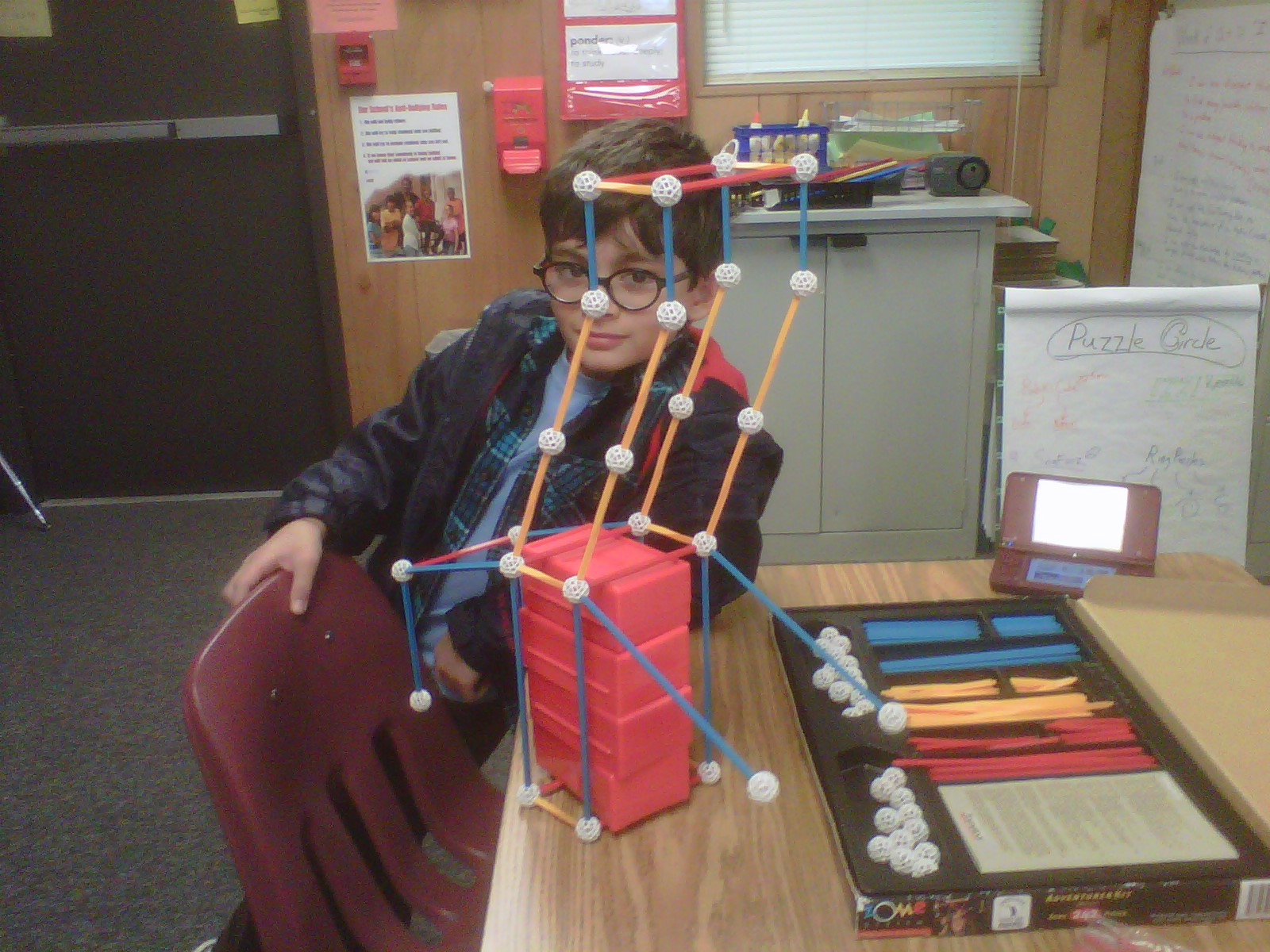
Santa's Got a Brand New Sleigh: Our QUEST "ZOME" Challenge
"ZOME" is a very versatile construction kit/system that we love to use for specialized design and construction problem-solving challenges. This week, most of our 3rd, 4th and 5th graders participated in a very season-appropriate challenge. : )
Here's how it was presented:
And this is how they used ingenuity, creativity and design to meet the challenge:
Here's how it was presented:
Santa has been riding the same-old sleigh for years and years, but he’s decided it’s time for an upgrade! He needs a sleigh that will last for the next 100 years, so he wants the brightest young minds of the next century—you—to help him design it.Here’s your job: use the ZOME construction pieces to create a model of Santa’s new sleigh. Plan and build carefully, though, because your sleigh will be judged and scored on the following criteria:· Name (10 pts)Give your sleigh a catchy, original name.· Stability (20 pts)Santa’s sleigh has been known to bump into chimneys and rooftops and even crash into trees now and then. Your sleigh should be able to handle some basic bumps and thumps. Mr. Koch will “bump test” it.· Strength (??? Pts)Santa piles a lot of toys onto his sleigh. The new design has to handle a lot of weight. Mr. Koch will test the strength with a bucket of gram weights. You’ll get a point for every gram it can handle without bending or breaking.· Aerodynamics (15 pts)Santa has a lot of ground to cover and speed is of the essence. Your design should make it easy to go fast through the air.
- Holiday Flair (10 pts)It is Santa’s ride, after all, so it should have some flavor of the holidays.
 |
| "HO-licopter" |
 |
| "Santa's Ornament Airplane" |
 |
| "NYAN Cat" |
 |
| "Toy Tanker" |
 |
| "Snowflake Truck" |
 |
| "Snowflake Sleigh" |
 |
| "Dynamic Deliverer" |
 |
| "Eve XL" |
 |
| "S.S. Power" |
 |
| "Santa's Savior Sleigh" |
 |
| "S.S. Santa" |
 |
| "Gift Giver 2000" |
 |
| "Santa Bear's Jingle Bell Sleigh" |
 |
| "Faster Caster 3000" |
 |
| "Death Sleigh of Awesomeness" |
 |
| "Present Box 2000" |
 |
| "Candy Cane Coach" |
 |
| "Snowball Sleigh" |
 |
| "The HO-HO Hoboes" |
 |
| "Hanukkah Sleigh" |
 |
| "The Jingle Wringle" |
 |
| "Oh, Christmas Tree" |
 |
| "Pokesleigh" |
 |
| "Dasher 64" |
 |
| "Rocket Sleigh 44" |
 |
| "Jingle Sledder" |
Thursday, December 8, 2011
The Eleventh Hour: When Persistence Pays Off!


I am pleased to say the students proved my skepticism completely wrong! The Eleventh Hour turned out to be one of the most engaging and successful inter-disciplinary units I've ever facilitated. Kids were revved up until the very end, always eager from the moment I got them to the "closing bell" of our sessions. And this was hard stuff, folks! Here is just a sampling of the higher-level thinking skills the students were practicing as they engaged with the story and the mystery:
- deductive reasoning
- inductive reasoning
- logic
- analytical thinking
- visualization
- vocabulary-building (context clues)
- inference
- reading comprehension
- oral fluency
 |
| Students use a cipher wheel to crack the final code in The Eleventh Hour |
I know some of you have already gone out and purchased the book for home. I think it is money well spent. Students have been asking if there are other similar books. The author, Graeme Base, has also published Animalia, which is said to have a very similar feel. Worth checking out! Might help turn some of those long, video game-heavy days of holiday break into some productive brain and character building! : )
Thursday, November 10, 2011
"The Eleventh Hour" by Graeme Base: A Code Breaker's Dream!
We have been tackling a mystery that is putting a lot of our skills to the test! We are applying all our observation and deductve powers, as well as our growing toolbox of code breaking and deciphering skills to crack the mystery of Horace the Elephant's birthday feast in The Eleventh Hour: A Curious Mystery by Graeme Base. Third graders got a head start this week but next week our 4th and 5th graders will see if they can get to the truth as impressively as their underclassmen have been.
Here's a little teaser-trailer to give you a taste:
Here's a little teaser-trailer to give you a taste:
Wednesday, October 26, 2011
Christie Hinky Pinky Book Released!
Announcing the "publication" of the next two Hinky Pinky books from the wonderful minds of Christie GT students:
Here's a little sampling of the mind-boggling riddles in these two volumes:
What is a hink pink for a dustbin you put money in?
Answer: "Cash Trash" (Neerul)
****
What is a hinky pinky for a crying Barbie?
Answer: "A bawly dolly" (Logan)
****
What is a hinky pinky for a non-agreeing cat?
Answer: "A decline feline" (Jackie)
****
What is a hinky pinky for a magician who cut a kid in half?
Answer: "Tragic magic" (Allie)
****
What is a hinky pinky for a betting dog?
Answer: "Bingo dingo" (Joaquin)
- What is a Hink Pink? (4th)
- From Hink Pink to Hinkety Pinkety (5th)
 |
| Christie "Hinky Pinky" books now available in the library! |
What is a hink pink for a dustbin you put money in?
Answer: "Cash Trash" (Neerul)
****
What is a hinky pinky for a crying Barbie?
Answer: "A bawly dolly" (Logan)
****
What is a hinky pinky for a non-agreeing cat?
Answer: "A decline feline" (Jackie)
****
What is a hinky pinky for a magician who cut a kid in half?
Answer: "Tragic magic" (Allie)
****
What is a hinky pinky for a betting dog?
Answer: "Bingo dingo" (Joaquin)
Thursday, October 20, 2011
Brad Meltzer's Decoded: Stimulating T.V.

Not all episodes are directly related to codes, and some present alternative theories that may ruffle feathers, but I've never seen an episode that would be inappropriate for young viewers for any reason.
Get some more background and information on the show's homepage.
And I've just posted two complete episodes (both with code themes!) on the "Videos" page of this blog.
Enjoy!
Annual Parent Meeting Dates and Times
The annual QUEST parent informational meetings will take place on the dates/times below. This meeting is GT's version of "Curriculum Night" and the focus will be on briefly discussing the components of Frisco's Elementary GT curriculum.
Christie Elementary
Wednesday, November 9 - 7:45-8:15 am
Isbell Elementary
Thursday, November 10 - 7:45-8:15 am
For those parents who are not able to attend I will make any Powerpoints and/or handouts available via email.
Christie Elementary
Wednesday, November 9 - 7:45-8:15 am
Isbell Elementary
Thursday, November 10 - 7:45-8:15 am
For those parents who are not able to attend I will make any Powerpoints and/or handouts available via email.
Tuesday, October 11, 2011
Isbell Hinky Pinky Books Now "Published"!
The 4th and 5th grade Hinky Pinky books have been bound and "published" to the Isbell library! (Christie Editions coming very soon!)
 Rush Hour Riddles (4th Grade) and Epic Hinky Pinkies (5th Grade) will be available for viewing within the library. To preserve these very limited edition publications, we can't allow them to be checked out, but we hope that doesn't stop you from coming in to have a look!
"What do you call a hinkety pinkety for a love note for a monster?"
"A Frankenstein Valentine." (by Megan)
__
"What do you call a group of mouse friends who play hockey?"
"Ice mice." (by Karthik)
__
"What do you call a hink pink for a fat crustacean?"
"A flab crab." (by Christian)
__
"What do you call a hinkety pinkety for what the forefathers did when they messed up?"
"Constitute troubleshoot." (by Josh)

Here's a little sampling of what you'll find...
"What do you call a hinkety pinkety for a love note for a monster?"
"A Frankenstein Valentine." (by Megan)
__
"What do you call a group of mouse friends who play hockey?"
"Ice mice." (by Karthik)
__
"What do you call a hink pink for a fat crustacean?"
"A flab crab." (by Christian)
__
"What do you call a hinkety pinkety for what the forefathers did when they messed up?"
"Constitute troubleshoot." (by Josh)
Thursday, October 6, 2011
Status Check #1
With several weeks of QUEST now under our belt this year, it's time to give a short summary by grade-level of the types of thinking, problem-solving and exploring we've been up to.
ALL grade levels have been busy cracking the codes on the blog and I couldn't be more happy! The persistence and determination that many students have demonstrated is truly impressive. We are fostering these codebreaking skills directly and indirectly with our logic warm-ups and discussions every session. The extra codebreaking they do on the blog reinforces their knowledge in logical reasoning, history and culture in addition to building the character traits mentioned above.
1st/2nd:
With our youngest QUEST students we've been building our foundation in core thinking skills. These ways of thinking will be the framework for most of the higher-order thinking we do throughout the next few years of QUEST and beyond. We've begun with a focus on DEDUCTIVE thinking. We've used a character named "Dudley Detective" (who happens to be a dog) to explore this type of logic through stories and scenarios. Here is what we've learned so far about DEDUCTIVE thinking:
3rd:
Our third-graders started off exploring the topic of STEGANOGRAPHY--the art of hiding a message in plain sight. After building some historical background on how this has occurred throughout history, we applied our creative thinking skills to come up with a way of hiding "Grandma's secret recipe" from potential thieves and spies as we travelled through the airport. Parents beware, you have some clever little spies of your own!
Next, we learned a method called a NULL CIPHER. A null cipher involves hiding a written message inside another written message. We closely studied a real example from history in which a null cipher literally saved a life, then once again put our creative skills to the test. We were trapped at an evil summer camp and had to get a message to our parents to rescue us. The problem is that the evil counselors censor all the letters so we had to hide the real message inside a an innocent message. Each student devised his/her own null cipher method an I am happy so say every student managed to get him or herself saved by outwitting the counselors!
Finally we've practiced the PINHOLE CIPHER. If you find some suspicious "pin pricks" in your magazines and newspapers at home that may be why.
4th/5th:
We've started our exploration of codes on a project of verbal coded riddles called "Hinky Pinkies." These hilarious but clever rhyming mysteries actually require some higher order verbal and linguistic acrobatics to create! We've collected final copies from every student and compiled them into a class book, soon to be published in the school library!
Next, we've begun a mini-unit on the Navajo Native American codetalkers of WWII. Did you know about this fascinating chapter of American history? Does Nicolas Cage in the movie "Windtalkers" ring a bell? To raise interest we watched the official movie trailer and discussed the historical context. Then, to futher explore the Navajo perspective of the story we read and discussed "The Unbreakable Code" by Sara Hoagland Hunter. This will evolve into a short research unit in the next couple weeks.
SPECIAL NOTE: Although the trailer was completely appropriate, the movie "Windtalkers" is rated R. Please only allow students to view at your careful discretion.
P.S. There is NOT a hidden coded message in this particular post!
ALL grade levels have been busy cracking the codes on the blog and I couldn't be more happy! The persistence and determination that many students have demonstrated is truly impressive. We are fostering these codebreaking skills directly and indirectly with our logic warm-ups and discussions every session. The extra codebreaking they do on the blog reinforces their knowledge in logical reasoning, history and culture in addition to building the character traits mentioned above.
1st/2nd:
With our youngest QUEST students we've been building our foundation in core thinking skills. These ways of thinking will be the framework for most of the higher-order thinking we do throughout the next few years of QUEST and beyond. We've begun with a focus on DEDUCTIVE thinking. We've used a character named "Dudley Detective" (who happens to be a dog) to explore this type of logic through stories and scenarios. Here is what we've learned so far about DEDUCTIVE thinking:
- There is only one right answer.
- You must collect multiple facts.
- You must be patient and not jump to conclusions.
- You might have an "I got it!" moment in which the answer becomes clear.
3rd:
Our third-graders started off exploring the topic of STEGANOGRAPHY--the art of hiding a message in plain sight. After building some historical background on how this has occurred throughout history, we applied our creative thinking skills to come up with a way of hiding "Grandma's secret recipe" from potential thieves and spies as we travelled through the airport. Parents beware, you have some clever little spies of your own!
Next, we learned a method called a NULL CIPHER. A null cipher involves hiding a written message inside another written message. We closely studied a real example from history in which a null cipher literally saved a life, then once again put our creative skills to the test. We were trapped at an evil summer camp and had to get a message to our parents to rescue us. The problem is that the evil counselors censor all the letters so we had to hide the real message inside a an innocent message. Each student devised his/her own null cipher method an I am happy so say every student managed to get him or herself saved by outwitting the counselors!
Finally we've practiced the PINHOLE CIPHER. If you find some suspicious "pin pricks" in your magazines and newspapers at home that may be why.
4th/5th:
We've started our exploration of codes on a project of verbal coded riddles called "Hinky Pinkies." These hilarious but clever rhyming mysteries actually require some higher order verbal and linguistic acrobatics to create! We've collected final copies from every student and compiled them into a class book, soon to be published in the school library!
Next, we've begun a mini-unit on the Navajo Native American codetalkers of WWII. Did you know about this fascinating chapter of American history? Does Nicolas Cage in the movie "Windtalkers" ring a bell? To raise interest we watched the official movie trailer and discussed the historical context. Then, to futher explore the Navajo perspective of the story we read and discussed "The Unbreakable Code" by Sara Hoagland Hunter. This will evolve into a short research unit in the next couple weeks.
SPECIAL NOTE: Although the trailer was completely appropriate, the movie "Windtalkers" is rated R. Please only allow students to view at your careful discretion.
P.S. There is NOT a hidden coded message in this particular post!
Tuesday, September 27, 2011
Abe Lincoln and the Rail Fence Cipher

I wonder if Abe Lincoln ever sent a message like this?
WARDNCOE101FRPIE
EREOOTBR7R8OARZ
Good luck!
Tuesday, September 20, 2011
The Caesar Cipher
 |
| Caesar used a special cipher to communicate with his generals. |
WKLV LV RQH RI WKH ILUVW FLSKHU PHWKRGV XVHG LQ KLVWRUB. LW LV SUHWWB HDVB WR FUDFN. ZH ZLOO EH OHDUQLQJ DERXW KRZ LW LV FUDFNHG DQG KRZ LW OHG WR PRUH FRPSOLFDWHG FLSKHUV.
Oops! I seem to have accidentally written the previous paragraph using the famous Caesar cipher. Can you crack it? The diagram below and the website to the right might help.

Subscribe to:
Posts (Atom)